

The DAC M30, M40, and M60 advanced damped AC (DAC) cable test systems are integrated with partial discharge (PD) diagnostic capabilities up to 30 kVpeak, 40 kVpeak, and 60 kVpeak, respectively. The systems also assess cable ageing status based on dissipation factor (tan delta) estimation. PD mapping allows users to identify areas of PD along the length of the cable. Portable on-site DAC voltage tests in combination with non-destructive PD and tan delta measurements is unique and fundamental for reliable service of newly installed, repaired, or service-aged cable systems.
Models also exist for high voltage transmission class cables (DAC H200 or DAC H300)
DATA SHEET:
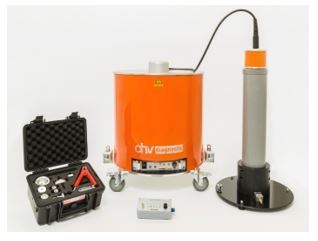
DAC M30 / M40 / M60 Features
Test voltages up to 30 kVpeak (Type M30), 40 kVpeak (Type M40), and 60 kVpeak (Type M60)
Higher test voltages available upon request
Performs testing according to IEEE 400.4
Test voltage frequency is comparable to operating voltage frequency
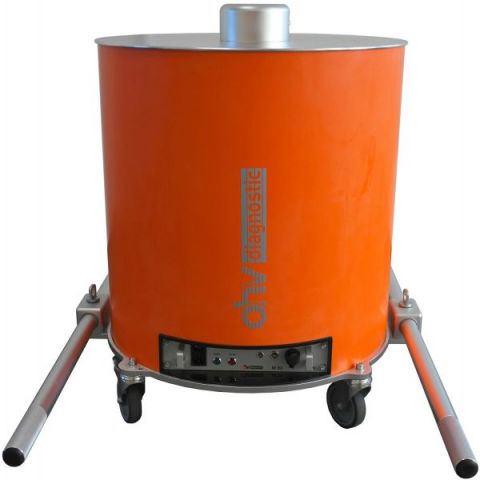
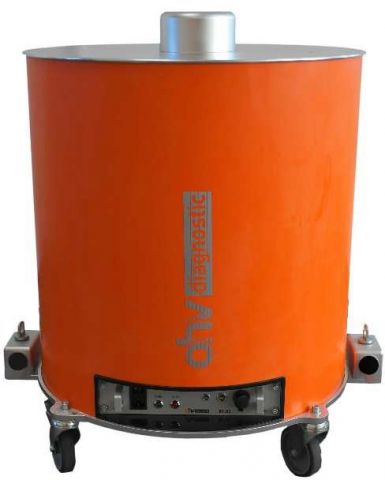
Supplied on castors with integrated control unit, HV supply, resonant inductor, divider, and PD measuring system
Easy lifting with included aluminum handle bars
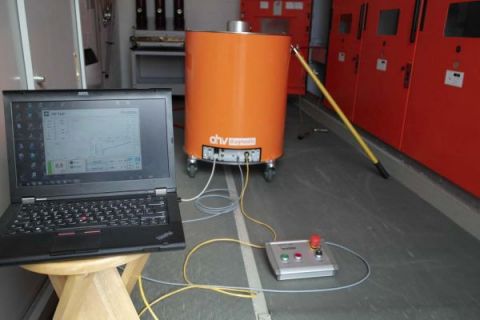
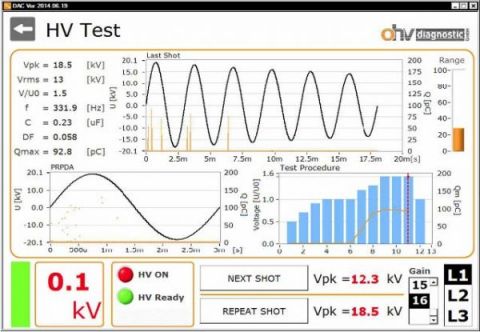
Measurement control and analysis via laptop with Diagnostic Suite software
Frequently Asked Questions About DAC M30 / M40 / M60
What is the DAC M30 / M40 / M60 cable test system?
The DAC M30, M40, and M60 are portable damped AC (DAC) test systems for on-site testing and diagnosis of medium voltage distribution cables. Manufactured by OHV Diagnostic and supplied by HV TECHNOLOGIES, Inc., each system combines a voltage endurance test, partial discharge (PD) measurement and location, and tan delta (dissipation factor) estimation in one unit. Maximum test voltages are 30 kVpeak (M30), 40 kVpeak (M40), and 60 kVpeak (M60).
How does damped AC (DAC) cable testing work?
A damped AC test system charges the cable to the selected test voltage with a DC power supply, then closes a switch that connects the cable to an inductor. The cable’s capacitance and the inductor form a resonant circuit that produces a decaying AC oscillation. On the DAC M30, M40, and M60, the oscillation frequency is 20–1,000 Hz depending on cable capacitance, in the near power frequency range, so partial discharges behave much as they do in service.
What is the difference between the DAC M30, M40, and M60?
The DAC M30, M40, and M60 differ mainly in maximum test voltage, weight, and height. The M30 delivers up to 30 kVpeak (21 kVrms) and weighs 75 kg (165 lb). The M40 delivers up to 40 kVpeak (28 kVrms) and weighs 80 kg (176 lb). The M60 delivers up to 60 kVpeak (42 kVrms) and weighs 90 kg (198 lb). All three have a 620 mm (25 in) diameter and share the same 20–1,000 Hz frequency range, 25 nF–8 µF test object capacitance range, and PD measurement specifications. Height is 690 mm (27 in) for the M30 and M40 and 890 mm (35 in) for the M60.
Which DAC model do I need for my cable voltage class?
Choose the DAC model whose maximum output covers the test voltage required for your cable under IEEE 400.4 or your utility’s own test specification. The M30 is rated 30 kVpeak (21 kVrms), the M40 is rated 40 kVpeak (28 kVrms), and the M60 is rated 60 kVpeak (42 kVrms). Systems with higher test voltages are available on request, and HV TECHNOLOGIES can help match a model to your cable voltage class and test plan.
How long a cable can the DAC M30 / M40 / M60 test?
The DAC M30, M40, and M60 test cables with a capacitance of 25 nF to 8 µF, which corresponds to approximately 20 km (12 miles) of medium voltage cable. For short cables whose capacitance falls below the minimum, the included 200 nF base load capacitor is connected to bring the test circuit into range. The base load capacitor is rated 30 kV for the M30 and 60 kV for the M40 and M60.
What standards does the DAC M30 / M40 / M60 comply with?
The DAC M30, M40, and M60 perform withstand voltage testing and partial discharge analysis in line with IEEE 400.4, the IEEE guide for field testing shielded power cable systems rated 5 kV and above with damped AC voltage, and IEC 60060-3, the IEC standard for high voltage test techniques used in on-site testing.
What cable defects can damped AC testing detect?
DAC voltage testing with PD analysis detects three main types of problems: insulation defects caused by poor workmanship during cable installation or laying, defects in cable accessories such as joints and terminations, and deterioration of the cable insulation due to ageing. This makes the DAC M30, M40, and M60 suitable for commissioning newly installed cables, verifying repairs, and assessing the condition of service-aged cable systems for asset management.
How does the DAC system locate partial discharge along a cable?
The DAC M30, M40, and M60 locate partial discharge sites along the complete length of the cable using time-domain reflectometry (TDR) and wideband PD location from 100 kHz to 20 MHz with automatic adjustment. The Diagnostic Suite software plots PD activity on a location map, so engineers can see whether discharges are concentrated at a joint, a termination, or a section of cable. Joint locating is integrated into the system’s calibration mode.
What is the partial discharge measuring range and sensitivity?
The DAC M30, M40, and M60 measure partial discharge from 5 pC to 100 nC with a resolution of 1 pC. A rechargeable PD calibrator is included for calibrating each measurement setup, and the Diagnostic Suite software provides phase-resolved PD analysis and pattern recognition to help identify the type of defect producing the discharges.
Does the DAC M30 / M40 / M60 measure tan delta?
The DAC M30, M40, and M60 estimate the cable’s loss factor (tan delta, also called dissipation factor) during the test by determining the damping factor between successive oscillations. Tan delta indicates the overall ageing status of the cable insulation and complements PD measurement, which pinpoints localized defects.
Is damped AC testing non-destructive?
The PD measurements performed by the DAC M30, M40, and M60 are non-destructive diagnostic methods. Because the damped AC voltage oscillates at a frequency comparable to the operating frequency and is applied in short, decaying bursts rather than as a long continuous stress, the insulation is stressed in a way similar to normal service. As with any withstand test, a cable with a severe defect may fail during testing, which is the intended way of exposing weak points before they fail in service.
What is the difference between DAC and VLF cable testing?
Very low frequency (VLF) testing typically applies a continuous voltage at about 0.1 Hz for an extended withstand period, while damped AC (DAC) testing applies short, decaying oscillations at 20–1,000 Hz, closer to the 50/60 Hz operating frequency. Because partial discharge behavior depends on frequency, DAC PD results tend to be more representative of service conditions. VLF field testing is covered by IEEE 400.2, and DAC field testing is covered by IEEE 400.4.
What power supply and site conditions does the DAC system need?
The DAC M30, M40, and M60 run on single-phase power from 94 to 250 V, 48 to 63 Hz, drawing 500 VA, so they can operate from a standard outlet or a small portable generator. The systems operate at temperatures from 0 to 50 °C (32 to 122 °F) and 5 to 90% relative humidity, non-condensing.
Is the DAC M30 / M40 / M60 portable?
Yes. The DAC M30, M40, and M60 are compact field test systems weighing 75 kg (165 lb), 80 kg (176 lb), and 90 kg (198 lb) respectively. They are supplied on castors with aluminum handle bars for lifting, and ship in rugged transportation and storage cases designed for travel to the cable test site.
What is included with the DAC M30 / M40 / M60?
The DAC M30, M40, and M60 are supplied with the DAC unit (control, HVDC power supply, switch, and PD detector), a 200 nF base load capacitor, rugged transport cases, a cable set with power supply, ground, and HV connection cables, a grounding rod, a safety box with emergency off and voltage control, a rechargeable PD calibrator with USB charging and signal cable, the Diagnostic Suite software, and an operating manual.
What software is used with the DAC test system?
The DAC M30, M40, and M60 are controlled from a laptop running the Diagnostic Suite software. The software runs programmable, automatic withstand voltage tests and includes TDR, PD location mapping, phase-resolved PD analysis, pattern recognition, and a test report generator.
Can the DAC system test high voltage transmission cables?
The DAC M30, M40, and M60 are designed for medium voltage distribution cables, and versions with higher test voltages are available on request. For high voltage transmission class cables, HV TECHNOLOGIES offers the DAC H200 and DAC H300 damped AC test systems.
Where can I buy the DAC M30 / M40 / M60 and get support?
HV TECHNOLOGIES, Inc., based in Manassas, Virginia, supplies the OHV Diagnostic DAC M30, M40, and M60 and provides training, calibration, and repair services. Request a quote using the form on this page, call +1-703-365-2330, or email hvsales@hvtechnologies.com.