

The MIDAS micro 2883 is a revolutionary Power Factor / Dissipation Factor and Capacitance tester used to test the insulation of high voltage components (i.e. transformers, bushings, capacitors, circuit breakers, surge arrestors, etc). Designed and tested for all types of conditions, the complete instrument is built in one rugged case with casters.
With its single-box design, weighing only 25 kg / 55 lbs, this tool can be easily transported to any testing location – in the field or in the factory. All accessories are stored in a robust duffel bag that can be affixed to the case itself. Cable drums make set-up and storage quick and convenient.
Datasheet:
Brochures:

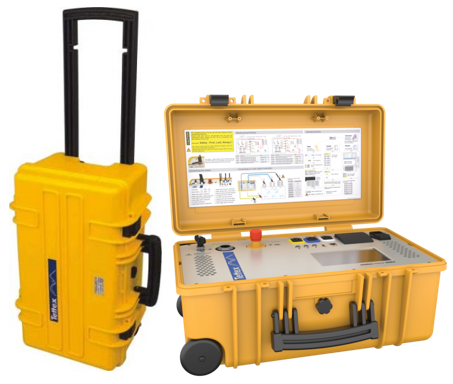
MIDAS micro 2883 Features
Shortest measuring time for power factor, dissipation factor (tan delta), and capacitance
Compact, one-box design (25 kg / 55 lbs)
7″ color touch screen for easy operation. No laptop or external devices required.
12 kV high voltage source
Variable frequency range of 15 – 400 Hz
Accuracy of 0.3% (capacitance) and 1×10⁻⁴ (tan delta)
Safe operation with interlock, emergency stop, safety checks and HV ground surveillance
Three operating modes: basic, guided, advanced
Rugged case with included accessories bag
Highest accuracy
Advanced interference suppression
Ability to measure tan delta of insulating oil quickly on site with the 6835 Portable Oil Test Cell
Request a Quote
MIDAS micro 2883 Common Applications
Bushings
Bushings provide an insulated entrance for an energized conductor into an equipment tank or chamber. Whether they are capacitively graded or bulk type (solid throughout), installed or spare, you can perform overall capacitance test, center conductor to tap test, tap insulation test and hot collar test with the MIDAS micro 2883.
Transformers
The dissipation factor or power factor test for distribution transformers and power transformers is a very comprehensive test for detecting moisture, carbonization, and other forms of contamination of windings, bushings, and liquid insulations for single-phase, three-phase and autotransformers. The scope of the power factor test for transformers is to determine the capacitance (insulation) between the individual windings and between the windings and ground as per IEEE C57.12.90 and IEC 60079-1 standards.
Shunt Reactors
Shunt reactors are used in HV systems to limit over-voltage surges associated with long transmission lines. The shunt reactor compensates the capacitive generation on power lines to avoid non-controlled voltage rise especially on lightly loaded lines. Similar to a transformer, power factor and capacitance testing are vital for assessing the health of insulation and detecting potential degradation.
Current Transformers
Current transformers (CTs) convert high transmission line current to a lower, standardized value to be handled by instrumentation. The measures are used for network control, protection and revenue metering. Substation current transformers have voltage ratings from several kilovolts up to the highest system voltages now in operation and are typically oil-filled but are also available as a dry type version, normally filled with SF6. The power factor test helps assess the insulation’s integrity and can detect early signs of deterioration, like moisture or contamination.
Capacitor Voltage Transformers
A capacitor voltage transformer consists of a capacitor voltage divider and an inductive/electromagnetic unit. The electromagnetic unit includes a transformer and a reactor whose inductance is adjusted in resonance to the equivalent capacitance of the voltage divider. The secondary voltage of the electromagnetic unit is proportional to the primary voltage and differs in phase from it by an angle which is approximately zero.
Cables
Dissipation-factor tests on cables are useful to indicate general deterioration and/or contamination. An increase in dissipation-factor with test voltage may be an indication of a serious general condition of corona in the insulation. With the MIDAS micro 2883 you are able to test several different types of cables such as single-conductor with shield or sheathed, single-conductor without shield or sheath, 3 phase unshielded enclosed in a common metallic sheath, 3 phase individually shielded and 3 phase unshielded.
Capacitors
Capacitance tests on power-factor correction, surge or energy storage capacitors test the insulation quality of the capacitor. Typically, capacitors are built using a series of single capacitor modules. If one module shows a problem, the result will affect average or overall capacitance of all connected modules. So, a small change in the measured total value could show a bigger problem in a single module.
Circuit Breakers
Power factor and capacitance testing are crucial diagnostic methods for assessing the insulation condition of circuit breakers. These tests help detect deterioration, contamination, and other issues that can compromise the breaker’s reliability and safety. For insulation measuring purposes high voltage circuit breakers can be classified into two groups. Live tank breakers whose interrupting chamber is on HV potential and dead tank breakers whose interrupter chamber is accommodated in an earthed metal housing.
Lightning Arresters
The surge arrester power loss test can reveal the presence of moisture, salt deposits, corrosion, cracked porcelain, open shunt resistors, defective pre-ionizing elements and defective gaps which hinder the lightning arrester’s main function. Lightning (or surge) arresters protect the electrical system by neutralizing discharge transient currents which are the result of lightning and switching. If a discharge transient current occurs it should close to providing a safe path for the excess electrical charge to flow to ground. Once the surge has passed and the voltage returns to safe levels, the arrester must stop conducting and return to its standby mode to prevent the flow of normal system power through it.
Frequently Asked Questions
What are the primary physical characteristics of the unit?
✔️ Weight: The instrument itself weighs 25 kg (55 lbs)
✔️Portability: It features a ruggedized one-box design with integrated casters for easy transport to remote locations.
✔️Interface: It includes a 7″ color touchscreen for standalone operation without the need for an external computer.
What equipment can be tested using this system?
The MIDAS micro 2883 is used for testing various high-voltage components, including Transformers (Power, Distribution, and Instrument), Bushings and Capacitors, Circuit Breakers, Surge Arrestors and Liquid Insulation samples.
What are the voltage and frequency specifications?
➡️Voltage Output: Adjustable from 25 V to 12,000 V RMS (@ 45–70 Hz)
➡️Frequency Range: 15 Hz to 400 Hz (when voltage ≤ 5 kV)
➡️Current Output: Maximum 180 mA RMS
Does the unit support temperature correction?
Yes. It features built-in temperature correction curves for different insulation materials to recalculate results to reference conditions, typically 20°C (68°F)
What is Interefrence Suppression?
The Midas Micro 2883 automatically suppresses electrical interference, allowing accurate measurements to be performed even in challenging test environments.
Nearby power-frequency fields can introduce electrical noise that affects measurement accuracy. The Midas Micro automatically detects these conditions and applies advanced filtering algorithms to remove interference and extract the true test signal. This helps ensure accurate and reliable measurements, even in challenging environments.
What are the three operating modes?
- Basic Mode: For quick, straightforward measurements showing only essential information.
- Guide Mode: Walks the user through measurements with safety and connection instructions on the screen.
- Advanced Mode: Provides flexibility for special test sequences and measurement procedures.
What safety features are included to protect operators?
✔️Emergency Stop: An easily accessible button to halt operations.
✔️Interlock Switches: Hand and foot interlock switches are available; the high voltage is disconnected if the safety switch is released.
✔️Open Ground Detection: Ensures high voltage can only be switched on if a proper ground connection is detected.
✔️Visual/Audible Warnings: Includes a warning sound and a warning lamp bar on the display.
✔️System Components & Accessories
What optional accessories are available?
➡️2883/SAFE: Safety strobe light with a magnetic base.
➡️288x/TEMP: Laser infrared contact-less thermometer/hygrometer.
➡️MIDAS Office: Software for offline data analysis and custom test sequence creation.
➡️6835: Test cell for on-site measurements of liquid insulation samples up to 10 kV[cite: 231].
How is the unit's accuracy maintained over time?
✅The unit uses a gas-filled standard capacitor as an internal reference, which ensures repeatable results and long-term stability regardless of temperature or humidity.
✅Automatic calibrations are performed during the self-test at boot-up
✅The unit is tested to MIL-STD-810G standards for reliability in rough environments
What are the main applications?
The device is used for testing:
✔️Power transformers
✔️Distribution transformers
✔️Instrument transformers
✔️Liquid insulation
✔️Bushings
✔️Capacitors
✔️Circuit breakers
✔️Surge arresters
What measurement capabilities does it have?
The MIDAS micro 2883 measures:
✅Dissipation Factor (tan δ)
✅Power Factor (cos φ)
✅Capacitance
✅Resistance (Rx)
✅Inductance (Lx)
✅Quality Factor (QF)
✅Power (P, Q, S)
✅Test voltage and current
How accurate is the device?
➡️Capacitance accuracy: ±0.3% rdg ± 0.3 pF
➡️Tan δ accuracy: ±0.5% rdg ± 0.0001 (50–60 Hz)
The internal reference capacitor has extremely high stability:
➡️*“tan δ < 0.00001… ageing < 0.01% / year.”*
What is included in the standard scope of supply?
The package includes:
✔️MIDAS micro 2883 instrument
✔️High‑voltage cable (20 m)
✔️Three shielded measuring cables (20 m)
✔️Ground cable
✔️Cable drums
✔️Safety interlock hand switch
✔️Bushing tap adapters
✔️Mini clamps
✔️Extension clamp
✔️Operating manual
✔️Calibration certificate
What environmental conditions can it operate in?
✅Operating temperature: –10 to 50°C
✅Storage temperature: –20 to 70°C
✅Humidity: 5–95% non‑condensing
What interfaces and data formats are supported?
✔️USB 2.0
✔️Ethernet
✔️Thermal printer
✔️Data formats: XML, CSV
Does it include temperature correction?
Yes.
The device includes built‑in correction curves for different insulation materials and recalculates results to 20°C (68°F). The predefined set of curves can be easily expanded or changed by the user.
What is the maximum DUT capacitance?
✅47 nF @ 12 kV, 50 Hz
✅39 nF @ 12 kV, 60 Hz