

The Damped Alternating Current (DAC) high voltage H300 is an exceptionally compact, lightweight, and versatile system for testing and diagnosis of high voltage transmission cables up to 288 kVpeak (204 kVrms). It is programmable and features automatic withstand voltage test, partial discharge (PD) measurement and analysis as well as PD localization. Control and analysis are user-friendly using the intuitive software.
DATA SHEET:

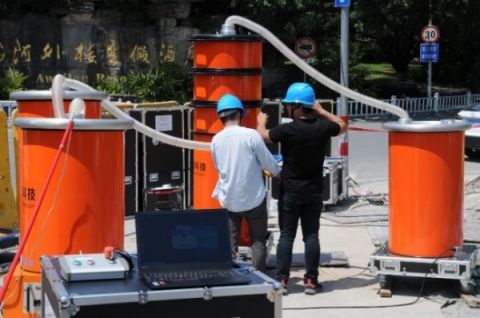
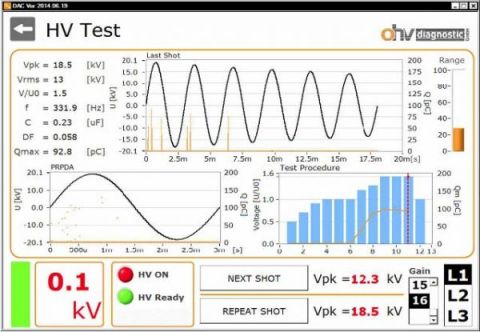
DAC H300 Features
Withstand voltage testing and PD analysis as per IEC 60060-3 and IEEE 400.4
Loss factor estimation (tan delta)
Maximum charging and peak voltage 288 kV
Includes 4 units, approx. 700 kg total
Rugged and robust transportation and storage cases
Easy and intuitive operation with included diagnostic software
Frequently Asked Questions About DAC M30 / M40 / M60
What is the DAC H300 damped AC test system?
The DAC H300 is a portable damped alternating current (DAC) test system for withstand testing and diagnosis of high voltage transmission cables up to 288 kVpeak (204 kVrms). It combines an automatic voltage endurance test, partial discharge (PD) measurement and analysis, PD localization, and tan delta (loss factor) estimation in one programmable system. HV TECHNOLOGIES supplies it in the US in partnership with ohv diagnostic.
What is damped AC (DAC) cable testing and how does it work?
Damped AC testing charges the cable under test with a high voltage DC source, then closes a fast high voltage switch that connects the cable to an inductor (oscillator coil). The cable capacitance and the coil form a resonant circuit that produces a decaying sinusoidal AC voltage, typically 30 to 500 Hz on the DAC H300. Because the oscillation is close to power frequency, it stresses the insulation much like service voltage while needing only a small 4 kVA supply.
What is the maximum test voltage of the DAC H300?
The DAC H300 delivers a maximum charging and peak output of 288 kVpeak, which equals 204 kVrms. The voltage rating can be adapted to a customer’s specific maximum test voltage requirement when the system is ordered.
What length and capacitance of cable can the DAC H300 test?
The DAC H300 tests objects with a capacitance from 30 nF to 3 µF, which corresponds to roughly 13 km (8 miles) of cable. The resulting oscillation frequency ranges from 30 to 500 Hz depending on the cable capacitance.
Which standards does the DAC H300 comply with?
The DAC H300 performs withstand voltage testing and partial discharge analysis according to IEC 60060-3 and IEEE 400.4. IEEE 400.4 is the IEEE guide for field testing and evaluation of shielded power cable systems rated 5 kV and above using damped alternating current voltage.
What partial discharge measurement capability does the DAC H300 have?
The DAC H300 measures partial discharge from 5 pC to 100 nC with 1 pC resolution. It locates PD sites along the complete cable length using wideband detection from 100 kHz to 20 MHz with automatic adjustment. An integrated joint-locating function in calibration mode helps map joint positions.
What cable defects can damped AC testing with the DAC H300 detect?
DAC voltage testing and PD analysis with the DAC H300 reliably detect three kinds of defect:
- insulation defects caused by poor workmanship during installation or laying
- defects in cable accessories such as joints and terminations
- insulation deterioration caused by ageing
When should the DAC H300 be used: commissioning, after repair, or maintenance?
All three. The DAC H300 assesses the insulation condition of newly installed cables (commissioning and after-laying tests), repaired cables, and service-aged cable systems. It goes beyond a pass/fail withstand test to PD and tan delta diagnostics, so its results support condition-based asset management of transmission cable networks.
How portable is the DAC H300 and how much does it weigh?
The DAC H300 ships as 4 units in rugged transportation and storage cases with a total weight of approximately 700 kg (1,540 lbs), depending on voltage rating. Each case has an 800 x 800 mm (32 x 32 in.) footprint and a height of 1,200 to 2,100 mm (47 to 83 in.).
What is included with the DAC H300?
The DAC H300 scope of supply includes:
- the HVDC generator, high voltage switch, oscillator coil (impedance), and measuring/coupling capacitor, in 4 rugged cases
- a cable set with power supply, ground and HV connection cables, plus a grounding rod
- a PD calibrator
- a rugged case for cables and accessories
- diagnostic software and an operating manual
What power supply does the DAC H300 require?
The DAC H300 runs from a 3-phase, 380 / 400 V, 48 to 63 Hz supply rated at 4 kVA. An isolating and matching transformer can be offered optionally to suit different input voltages. The low power demand is a key advantage of damped AC testing over continuous AC resonant test systems for long, high-capacitance transmission cables.
How does damped AC testing compare with VLF and resonant AC testing for transmission cables?
Damped AC uses near-power-frequency oscillations (30 to 500 Hz on the DAC H300), so PD behaves much as it does in service. Very low frequency (VLF, typically 0.1 Hz) testing can show different PD behavior especially in terms of PD repetition rate. Compared with continuous resonant AC test systems, DAC equipment is far lighter and needs only a few kVA of supply power, but it applies a decaying rather than sustained voltage. HV TECHNOLOGIES also offers the RSKF variable frequency resonant test system where a continuous AC withstand is required.
Where can I buy the DAC H300 in the United States?
HV TECHNOLOGIES, Inc., based in Manassas, Virginia, supplies the DAC H300 in the US. The company also provides installation, commissioning, training, calibration, and repair services. Request a quote at hvtechnologies.com/quote or call 703-365-2330.