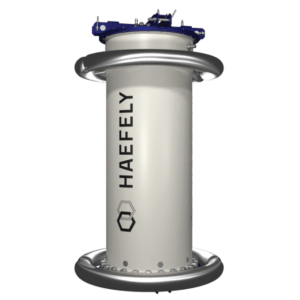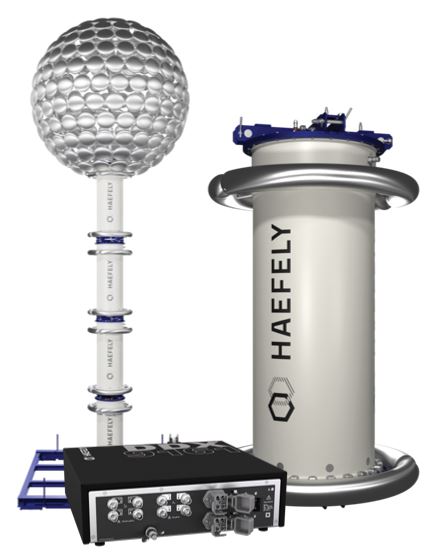
Transporting the “harvested” energy from offshore wind farms over great distances to the densely populated areas where electricity demands are high is a difficult undertaking. Subsea high voltage direct current (HVDC) transmission lines are the future for these underwater “electricity superhighways”. HVDC can transport more electricity, but almost more importantly, more efficiently than traditional AC transmission lines. A 2018 study conducted by the U.S. Energy Information Administration states:
DC transmission lines are more cost effective over long-distance applications, have lower electricity losses, are more suitable for underwater applications, can handle longer periods of overload operations, and can prevent cascading failures that propagate across the electric grid.
The demands for “greener” energy generation therefore also require “greener” energy transmission through the use of extra-long HVDC transmission lines.
A typical cross-section of an offshore wind farm power transmission can be seen below, which is from the wind farm “Sofia” off the coast of the UK in the North Sea. Electricity will be generated from the turbines of the wind farm and transported through subsea cables to an offshore converter substation platform where it will be converted from AC to DC. The electricity will then be transported via a 227 km (141 mile) subsea HVDC transmission link to an onshore converter substation, where it will be converted to AC again and fed into the existing AC distribution grid.

The erection of these wind farms and converter substations, as well as the laying of subsea cables is a vastly expensive undertaking. It is imperative that the HVDC cable assets are tested properly at the cable manufacturer to ensure no manufacturer defects are present and also on-site while the cable is laid to ensure no transportation damage has occurred. Furthermore, if a fault does occur while in service, a quick response to locate and repair is imperative so that the transmission of power can continue and potentially huge operating losses are kept to a minimum.
HVDC Cable Testing Solutions from Haefely
The PGR High Voltage DC Test Systems are designed to perform ultra high voltage direct current voltage tests on a variety of electrical assets, including bushings, transformers, and cables. The PGR is built with standard modules of
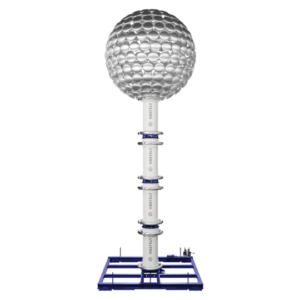
400 kVDC with the advantage of being able to stack modules to perform tests up to 2,000 kVDC. The modules are built on a frame with a small footprint to optimize test floor space in the laboratory or for designing mobile systems to be used on site. During the DC voltage test the PGR can also be used together with the DDX 9121b Digital PD Detector as a quality control test to measure partial discharge within the insulation of the HVDC cable under test.